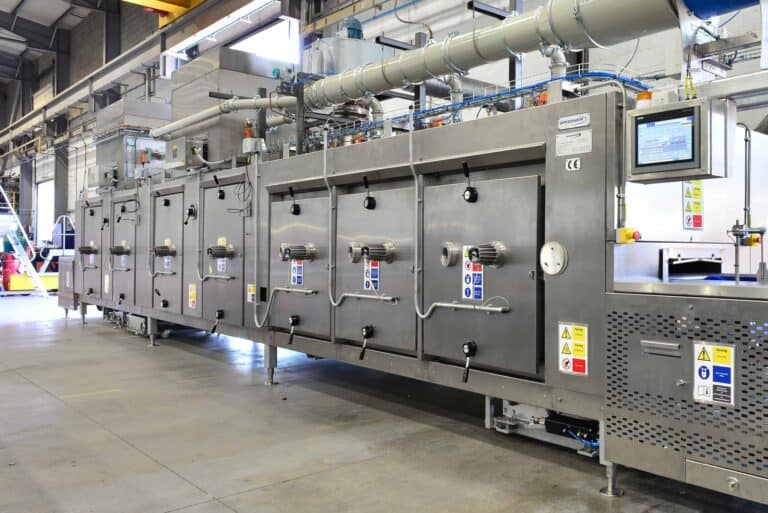
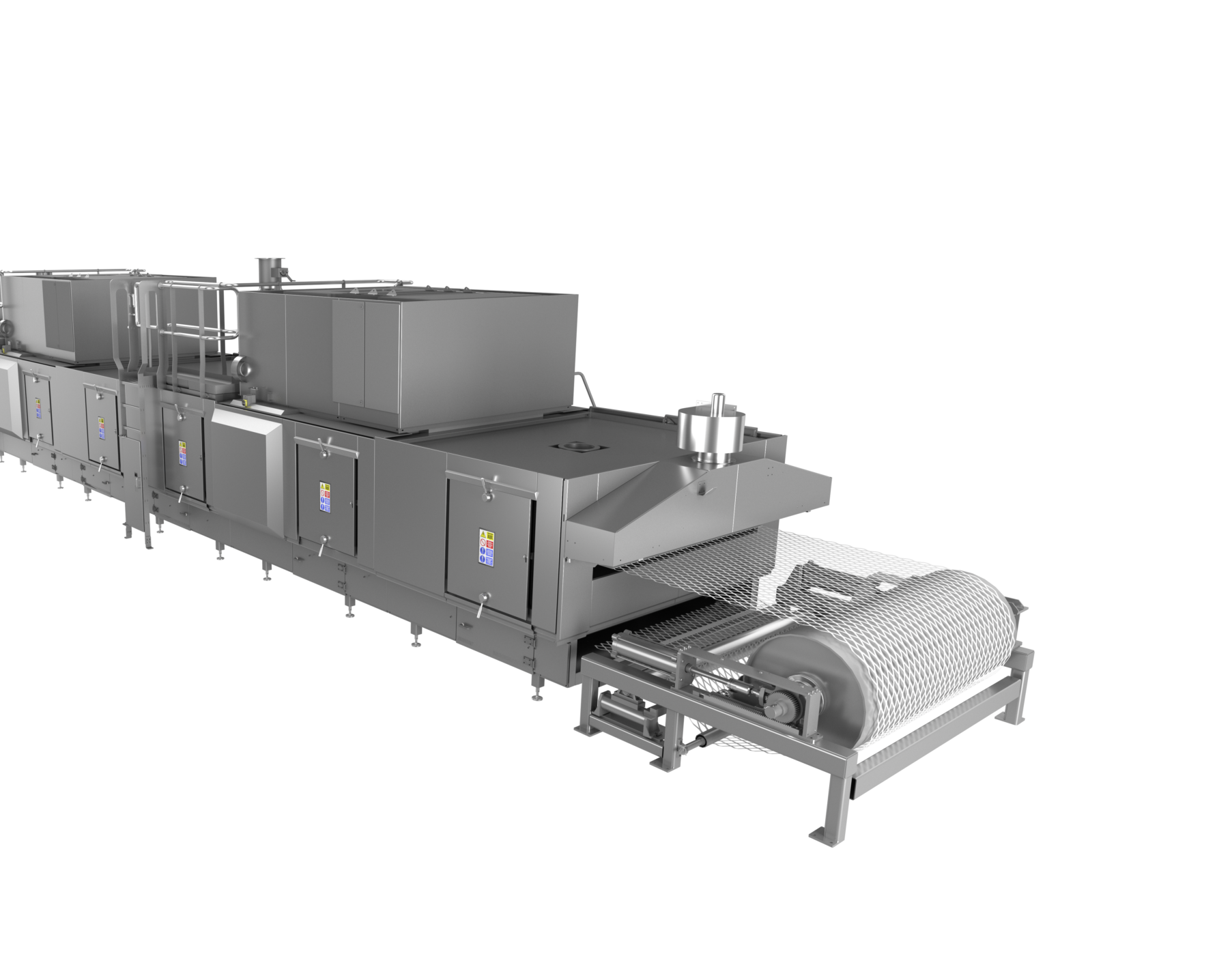
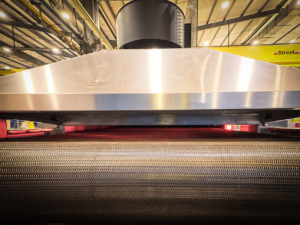
We develop industry-leading equipment designed for reliability, efficiency, and performance. With proven expertise across provers, ovens, dryers, and coolers, Spooner provides the dependability and versatility industrial bakeries need, coupled with superior control over the baking process.
Today, we’re pioneering the next generation of bakery technology with advanced dual-fuel and electric-ready equipment that deliver operational flexibility and future-ready performance.
Our industry-leading dual-fuel hybrid oven systems include a unique electric element that has been specifically designed for Spooner. Our hybrid technology has been extensively tested over the two-year development period to achieve performance metrics that outperform what is conventionally available in the market.
Every piece of Spooner equipment is configured precisely to your factory layout, production requirements, and future expansion plans. All modules are pre-wired and pre-tested, ensuring a quick and trouble-free installation and commissioning.
Spooner performs all key steps in the project life cycle in-house; from initial application scoping to final detailed engineering design and then on to fabrication, assembly and final testing before the equipment leaves the factory.
Our installation and commissioning teams then ensure your equipment is in production in the shortest time possible before our service team continues to support you well into the future.
We rapidly deploy our engineers anywhere in the world to ensure a seamless installation that fits around your existing production schedule.
Through our expansive in-house expertise, we have the knowledge and capability to work across all product types within the bakery sector.
Through SpoonerPlus, we offer comprehensive maintenance packages and ongoing technical support to ensure optimal operation of your equipment.
An international food manufacturer is adopting two pieces of innovative Spooner equipment: the L-Type Prover and the dual-fuel oven, both capable of a throughput of 12,000 tins per hour. To advance their sustainability credentials, this manufacturer, who is responsible for a large portfolio of FMCGs, will be utilising both natural gas and Polyfuel to power their new oven.
A globally-renowned pet food manufacturer is enhancing sustainable pet food manufacturing by adopting Spooner’s innovative hybrid oven technology in the form of two dual-fuel convection ovens, powered by a combination of solar power and natural gas.
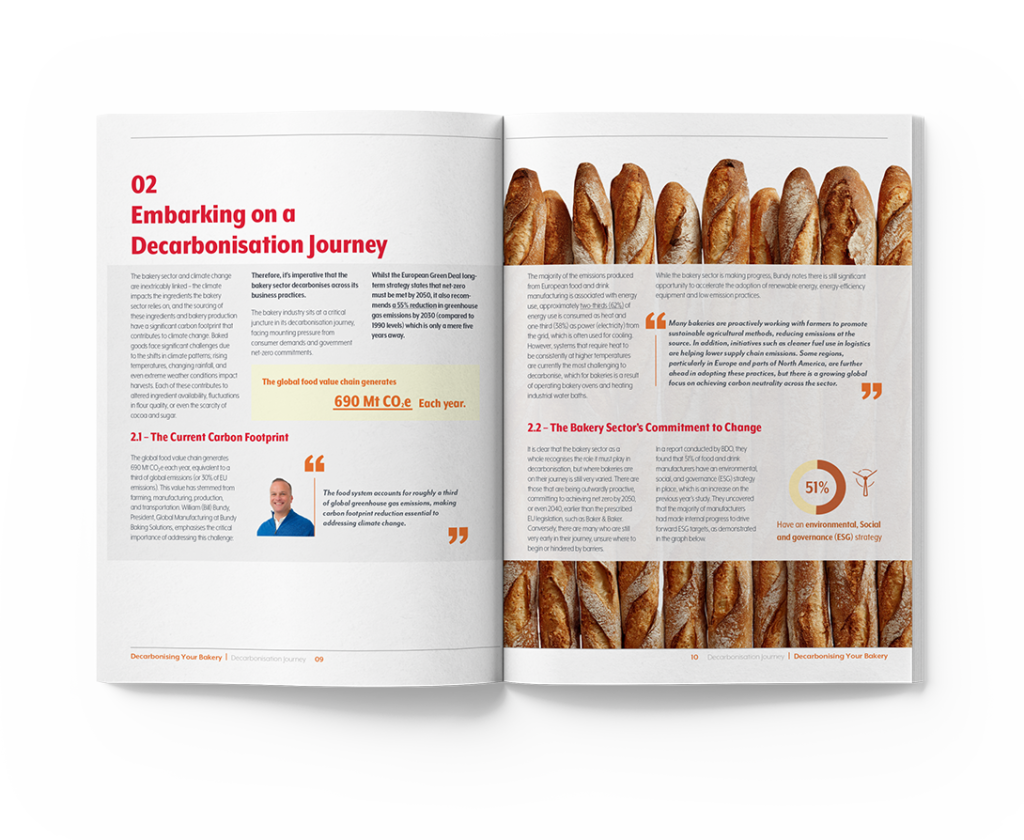
By 2050, bakeries are expected to be operating with net-zero emissions, and the carbon reduction of powering bakery equipment is an essential component of the decarbonisation journey.
At Spooner, we have a rich history of innovation, continually progressing the capability of our equipment, including introducing alternative fuel sources. Through Spooner Technology our hybrid and electric systems can deliver identical temperature, humidity, and velocity to maintain product consistency whilst considerably reducing your carbon footprint.
Ready to explore how Spooner can support your bakery?
Our technical specialists are here to discuss your specific requirements or answer questions about our hybrid technology.
For an oven that’s 50 years old and designed a long time ago; it’s going to be more difficult to retrofit new upgrades. We have refurbished ovens that have significantly degraded over the years, these need to be brought back to an acceptable standard first, including all repairs and remedial work necessary to do that.
It may not be financially viable to convert to electric if the equipment is in a poor state of repair and you’re losing heat everywhere.
Then there’s also the location and positioning of the equipment. Where bakeries have expanded over the years, you might find an oven right in the middle of a bakery surrounded by other equipment added over the years. Space is a premium in a lot of bakeries – If you want to fit a heat recovery system for example, the heat recovery unit is ideally installed in close proximity to the oven with minimal ducting between it and the oven. The further away the two are, the longer the ducting length, resulting in increased energy losses.
Bakeries also have to consider regulations. If an efficiency upgrade or retrofit is deemed to be a major modification to the oven, it may be necessary to upgrade the rest of the equipment to meet current regulations. That might include a full rewire of an oven, a new control system, upgraded safety circuit etc. which all add additional cost. By the time you’ve started down this road, you might be looking at considerable additional costs, so it’s important to balance this against a full replacement.
Our hybrid ovens can deliver identical temperature, humidity, and velocity to the product, regardless of the fuel used. Therefore, from a baking perspective, the conditions that impact baking quality are accurately monitored and controlled. We conducted extensive pilot baking tests to ensure that there were no changes detectable to a client’s products with our hybrid system.
By continuing to use the site, you agree to the use of cookies. more information
The cookie settings on this website are set to "allow cookies" to give you the best browsing experience possible. If you continue to use this website without changing your cookie settings or you click "Accept" below then you are consenting to this.