

Flexible Food Equipment: Baking
Following on from our recent blog focusing on the processes of manufacturing baked goods and how Spooner can support you in maintaining end product consistency, quality, using the most efficient process possible, in regards to proving, we now focus on baking.

Unsurprisingly baking is an essential part of producing baked goods. When baking with tunnel ovens there are two main oven styles: radiant and forced convection. Each has its benefits and lends itself to certain products. There are also occasions where both radiant and forced convection is required, and for this, Spooner can offer a single hybrid industrial oven which incorporates both baking type processes for a continuous bake.
Radiant and forced convection derive their names from the type of heat transfer used for the baking process. The main principles of these are:
Radiant Ovens
- Radiant heat transfer
- Numerous heat sources in each section
- Little to no airflow within the oven
- Shorter bake times
- Thinner or lighter weight products
- Top or bottom heat transfer or a combination of both
Forced Convection Ovens
- Convective heat transfer
- Single heat source in each section
- Large amount of airflow within the oven
- Large range of bake times
- Suitable for multiple products
- Top or bottom heat transfer or a combination of both
- Option to bypass airflow to allow for radiant heat transfer
With a radiant oven the points of adjustment are temperature, bake time and exhaust flow. Each of these will have differing effects on the baked product and result in the end product having a different texture and consistency. Radiant industrial ovens are suitable for baking a product with a hard crust, such as a baguette, or a product with a short bake time such as a flatbread.
Changing the parameters allows for numerous bake profiles from the same oven. For example, having a lower temperature at the front of an oven and a higher temperature at the back, with the correct bake time, would produce a hard crusted loaf/piece of bread which has a darker finished colour. Using this setup for a product such as flatbread would result in a product over coloured on the outside and underbaked on the inside – the same oven is still suitable for both products, providing the setup is changed accordingly.
Using a radiant oven with both top and bottom heat transfer allows for further flexibility on the finished product and its appearance, for example an uneven transfer top to bottom in the final section of the oven would leave the product darker on either the top side or the bottom side.
Industrial oven exhaust also has a substantial effect on the baked product. As a product bakes, it also dries and moisture is released into the baking chamber of the oven. Depending on the product being made, this moisture is either kept in the chamber or expelled. One example of this is cake baking – obviously a dry cake is not the desired outcome, therefore low exhaust air levels would be needed in the chamber to maintain a humid and favourable environment. The opposite of this would be producing a baked snack which is effectively dried as much as it is baked. To achieve the desired crispness, the exhaust air level would need to be at its maximum, whilst still maintaining a constant temperature in the oven.
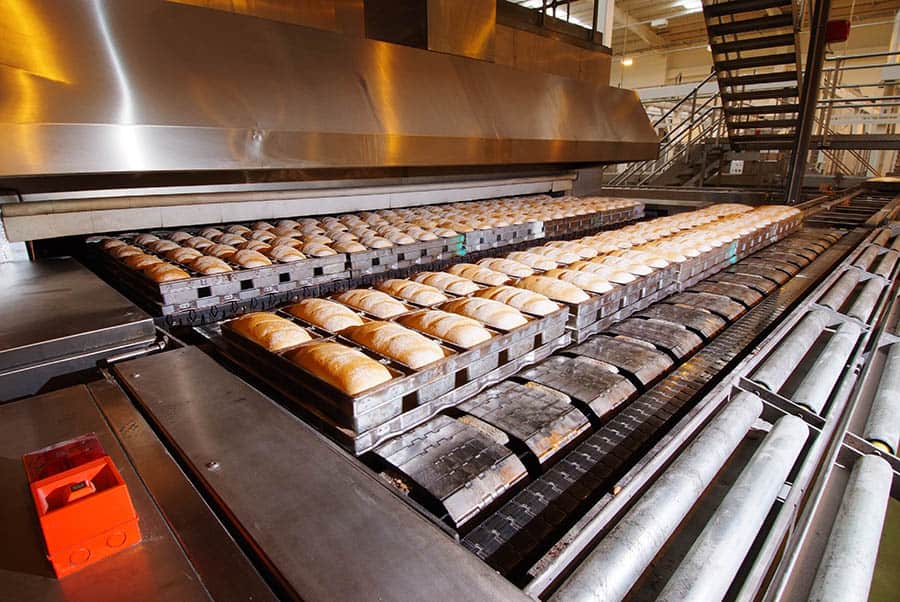
A forced convection oven uses very different principles to bake in comparison to a radiant oven. The main mode of heat transfer in a forced convection oven comes from high temperature air impinging on to the product from both the top and the bottom. This form of baking is suitable for essentially all products including ready meals, savoury pies, pastries, desserts, bread, snacks and much more. The flexibility of a forced convection oven allows differing levels of heat transfer due to the variable controls within each section.
In each section of a forced convection oven there are four impingement dampers which can be adjusted to increase or decrease the level of air on to the product and therefore the heat transfer. Along with the impingement dampers there is the option to include ‘bypass’ dampers which allow the hot air to be circulated within the baking chamber rather than directly on to the product and offer more of a radiant environment.
Another adjustable element within a forced convection oven is the heat source. This can be adjusted to suit the product being made. A high temperature with low impingement can offer the same level of heat transfer as a lower temperature with a high level of impingement. This is because the temperature and airflow are both a function of each other when looking to achieve a specific level of heat transfer.
As with a radiant oven the exhaust will influence the final product. With certain products such as tinned bread, a low exhaust would be desirable to minimise weight loss and allow the oven to run as efficiently as it can. Also, if a product requires a drier environment within an oven, such as savoury biscuits, then a higher level of exhaust would be desirable to remove moisture from the baking chamber. The Spooner forced convection ovens can be individually adjusted across each of the sections depending on the nature of the product being baked. So, if a product requires different levels of humidity at different stages, the Spooner forced convection oven can achieve this.

With accurate adjustments to temperature within an oven section, along with four adjustable impingement dampers and bypass dampers, there is a vast number of baking profiles achievable in each oven section. With only three sections, a Spooner forced convection oven could be set to perfectly bake a product. The same oven would be capable of producing Yorkshire puddings which would need an initial high heat transfer to the bottom of the product to allow for it to rise. The second section would give a more even distribution top to bottom to achieve the desired structure within the product and the final section would have a higher heat transfer from the top to colour the product. The same oven used to bake Yorkshire puddings could also be used to bake something such as an English scone, a product that requires an evenly distributed heat top to bottom at the front and middle sections of an oven and more heat transfer to the bottom in the last section.
The key characteristics of these ovens are:
- Multiple zones allow a variety of baking profiles to be obtained
- Four independent dampers per zone give added flexibility of air flow and temperature
- Adjustable burner controls for each zone
- Radiant dampers feature to convert forced convection into radiant heat for control of product colour
- Zone temperatures and air velocities can be recipe controlled


Another adjustment possible within a forced convection tunnel oven would be the use of steam injection; there are multiple uses and requirements for steam injection within baking. Steam injection can be utilised when baking goods that have a ‘sheened’ finish, such as brioche, and can help create flour dusted products – the steam helps the flour adhere to the product as well as wetting it to prevent burning as the moisture evaporates.
Finally, each baking type and profile is achievable with several heat sources from LPG, fuel oil, hydrogen or electric. The heat source does not fundamentally change the baking profile or method of heat transfer to the product.
Keep a look out for our upcoming blog on cooling.
If you want to find out more about our range of Industrial Provers, Industrial Ovens, Industrial Coolers, Heat Recovery Systems or our test and R&D facility, contact us here or call +44 (0)1943 609 505.
Don’t forget to follow us on LinkedIn to stay up to date with news, developments and announcements.


